Zespri: Turning Curiosity into Consumption
Sometimes the biggest barrier to buying a product is not price, awareness, or quality. It is a small moment of uncertainty.
That was the case with Zespri in the Middle East. People liked kiwi fruit. They enjoyed the taste. But many consumers simply did not buy it because they were unsure how to eat it.
The fruit had developed a reputation for being messy or inconvenient. Some believed it required peeling. Others were unsure whether the skin should be eaten. In supermarkets across the GCC, that small hesitation was enough for people to choose something else.
The campaign we developed at Horizon FCB Dubai started with a simple question.
What if the problem was not awareness of the fruit, but uncertainty about how to enjoy it?
A small behavioural barrier with big commercial impact
Zespri is one of the world’s most recognised kiwi brands, known for its quality and distinctive produce. Yet in the GCC market, consumption habits were still developing.
The issue was not product perception in the traditional sense. People did not dislike kiwi. They simply perceived it as slightly inconvenient compared to fruits that could be eaten instantly.
When a product feels complicated, it quietly loses against easier options. For Zespri, solving that perception required shifting behaviour, not just communication. Instead of telling people why kiwi was good for them, we needed to show them how easy it was to eat.
Turning instruction into entertainment
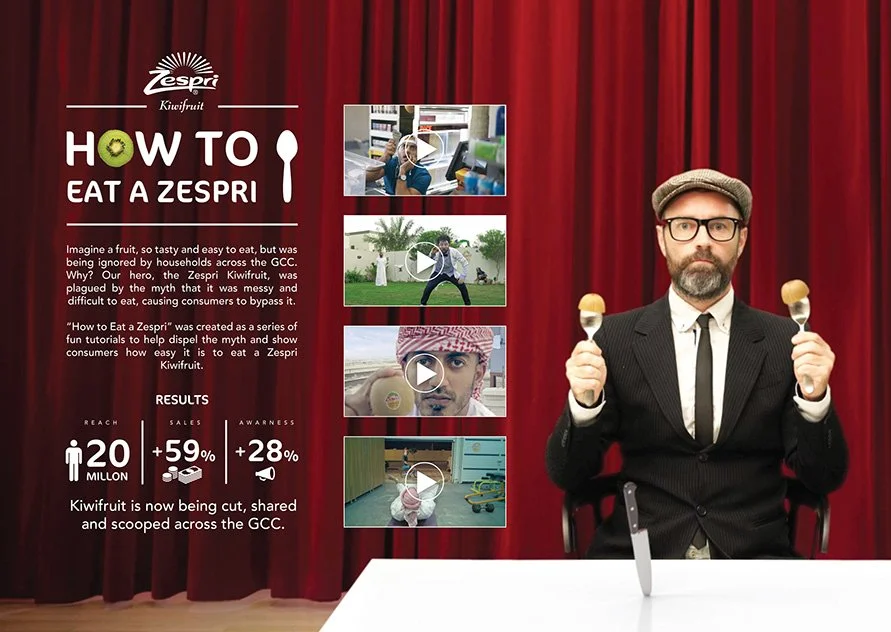
From that insight, the idea for “How to Eat a Zespri” was born. The campaign took the form of a series of playful tutorial-style videos demonstrating different ways to enjoy a kiwi fruit. Each execution focused on a simple action.
Scoop it. Slice it. Share it.
The tone was deliberately unexpected. Rather than instructional content that felt like a cooking demonstration, the films used humour and personality to make the process entertaining and memorable. The goal was not to educate in a formal way. It was to remove hesitation. Once people saw how simple it was, the barrier disappeared.
Social-first storytelling
Because the objective was behaviour change, the campaign was designed primarily for digital and social platforms.
Short-form videos allowed the concept to travel easily across feeds and be consumed quickly. Each piece of content acted as a small discovery moment, showing a new way to approach the fruit.
The visual language was simple and theatrical. Bright colours, exaggerated gestures, and playful framing helped transform a practical demonstration into something distinctive enough to stop people scrolling.
What could have been a functional tutorial became an entertaining micro-format designed for social sharing.




From curiosity to habit
As the campaign rolled out across the GCC, it reached millions of consumers and began reshaping how kiwi fruit was perceived.
What had previously felt unfamiliar or slightly inconvenient now felt approachable. When people understand how to use a product, curiosity quickly becomes habit.
The results reflected that shift.
Reach: 20 million
Sales: +59 percent
Brand awareness: +28 percent
More importantly, kiwi fruit began appearing more naturally in everyday consumption across the region. People were slicing it, scooping it, sharing it. Exactly as the campaign suggested.
What I learned
This campaign reinforced something I have seen repeatedly in marketing.
Growth does not always come from louder communication or bigger campaigns. Sometimes it comes from identifying a small behavioural barrier and removing it.
In this case, the challenge was not convincing people that kiwi was good.
It was simply showing them how to eat it.
Once that hesitation disappeared, the product could speak for itself.
